---
title: Where AI can add value to your business and how to estimate its cost
description: How to identify AI opportunities in your business, understand their
potential and estimate the effort and cost of turning them into improvements.
author:
name: Walter Jerusalinsky
title: AI strategy and implementation
url: https://www.linkedin.com/in/walter-jerusalinsky/
canonical: https://www.idoneos.com/en/applied-ai/discover-opportunities/
image: ../resources/opportunities.png
source: applied-ai/discover-opportunities/index.md
---
In any activity, we transform available resources into something we need: information into a decision, knowledge into a solution, materials into a product. Technology expands our ability to make those transformations. Its value depends on what it enables us to achieve in relation to our goals and on the resources required to operate it.
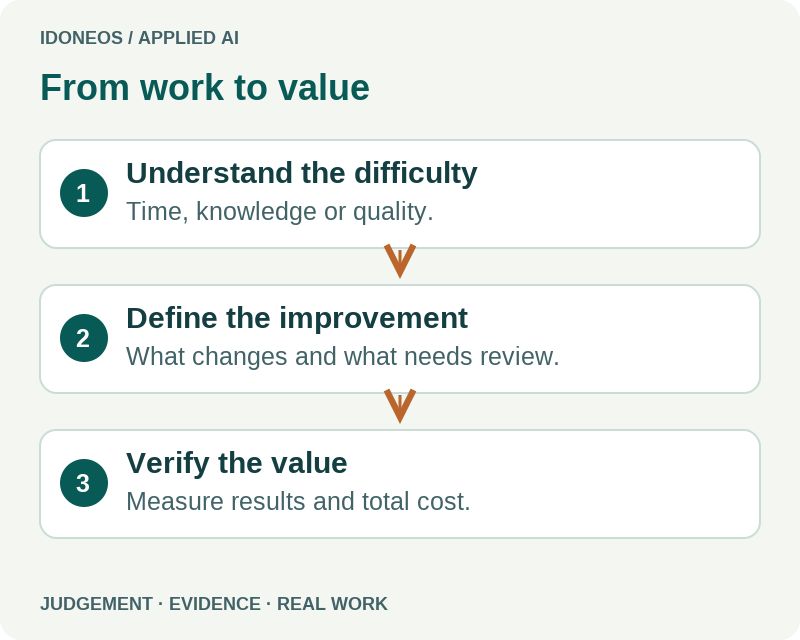
To recognise where artificial intelligence can contribute, we need to understand the work we want to improve. What result are we seeking? What prevents us from achieving it with the quality, speed or effort we need or would like?
The difficulty may lie in finding scattered information, interpreting documents, recognising patterns or preparing an explanation. There may also be an opportunity we have yet to pursue: analysing cases that currently go unexamined or providing a service that is too costly with the means available, but could become feasible by introducing new technologies.
## From purpose to a concrete task
“Introduce AI” expresses a technological intention. To turn that intention into a useful project, we need to connect it to a concrete, measurable transformation.
We might, for example, aim to reduce the time needed to prepare a report. But that work contains several different operations: gathering background information, checking data, performing calculations, interpreting results and writing conclusions. Distinguishing them lets us examine where the difficulties lie and which capabilities could resolve them.
A *language model* could help organise the background information and prepare a draft. Calculations can be performed by specific functions made available to the model as *tools*; current data must come from the relevant *data sources*. The solution brings these capabilities together and coordinates them according to what the task requires.
Breaking the work down into tasks lets us specify what input the system receives, what information it needs, what output it produces and how the result is checked. It can also reveal which parts of the problem can be resolved by organising information or improving a procedure.
## How a capability becomes an improvement
A tool's ability to perform an operation is a necessary condition for its use, but we also need its result to be good enough, arrive at the right time and be usable with a reasonable amount of effort.
For example, a summary may be well written yet omit the very condition that would change a decision. To judge its usefulness, we need to define what information it must preserve and who or what can check that it does.
The diagram shows this relationship in a task that uses information: resources support the preparation of a proposal, and evaluation checks whether the result can be used.
The capability is connected to a task and evaluated according to its purpose. A usable result lets us study what improvement it produces. View larger diagram.
Value becomes visible when that capability changes something that matters to us: reducing delays, avoiding errors, handling more work or making a new activity possible. We need to understand and be able to explain how that desired consequence would arise.
Suppose, as a hypothetical example, that a task occurs 40 times a week and AI assistance reduces its duration from 18 to 8 minutes, including review. The difference would be 400 minutes a week: 6 hours and 40 minutes.
That calculation represents released capacity. To assess its benefit objectively, we need to estimate how that capacity could be used. It could help clear pending work, increase production, reduce overtime or simply make work less stressful, and each possibility has different consequences and results. If the released time is fragmented, it may be difficult to use for some goals but useful for others.
## What to include in the total cost
Building each capability may require preparing information, unifying data sources, connecting systems, developing an interface, evaluating results and training the people who will use it. During operation, costs include services, review, maintenance, training new employees and resolving problems.
We should therefore distinguish the initial investment from recurring costs and estimate both for a defined volume of work. People's time belongs in that estimate.
There will be uncertainties at the beginning. We can express them as ranges and identify what they depend on: source quality, the number of connections, case variety or review effort. Subsequent evaluation will allow us to replace some assumptions with observations.
An opportunity is sufficiently defined when we can explain what we want to improve, where AI would contribute, which conditions it needs and how we will recognise its contribution—in other words, its results. With that description, we can compare it with other opportunities and decide where to begin.
Next step
Choose an opportunity to start with
We can now describe what could improve. Next, we need to decide what deserves an initial investment of time and resources.