---
title: "From experiment to everyday work: integrating an AI solution"
description: How to develop and integrate an AI improvement so that people can
use it, maintain it and sustain its value in everyday work.
author:
name: Walter Jerusalinsky
title: AI strategy and implementation
url: https://www.linkedin.com/in/walter-jerusalinsky/
canonical: https://www.idoneos.com/en/applied-ai/integrate-into-daily-work/
image: ../resources/integration.png
source: applied-ai/integrate-into-daily-work/index.md
---
During a proof of concept, we can prepare the data carefully and support each run. In everyday work, however, the solution uses actual data sources, unexpected situations arise and people need to complete their tasks within the time available.
Integrating a solution means building the conditions that allow its capability to be used routinely. It includes technical development, process organisation and learning by those involved.
The evidence from the test guides this work: it helps define which capability has been sufficiently verified and which limits the first version must retain.
## Give the automated capability a place in the everyday workflow
We need to understand when interaction is needed, what information the person has at that moment and what they should be able to do with the result.
If using AI assistance requires entering data again, switching applications and reconstructing references, that effort will consume part of the expected benefit. The interface and connections must support the workflow.
Each system state needs to be recognisable: what is ready, what is missing and what the next action is. When information is missing, the system should help obtain it. When review is required, it should show what is being reviewed and which resources can be used to check it.
This design connects the technical capability validated in the proof of concept to the everyday conditions in which people will be able to use it.
## Preserve the meaning of decisions
Preparing a proposal, approving it and executing an action are different operations. The system needs to preserve that distinction.
An approval must apply to the content reviewed. If a relevant detail changes afterwards, we will need to determine whether another review is required. Similarly, a pending action must be distinguishable from a completed one.
Interruptions also need a way forward. If a query fails, it must remain clear which information has yet to be checked. If an operation is retried, the design must prevent duplicate effects.
Handling these states lets work continue without having to guess what happened.
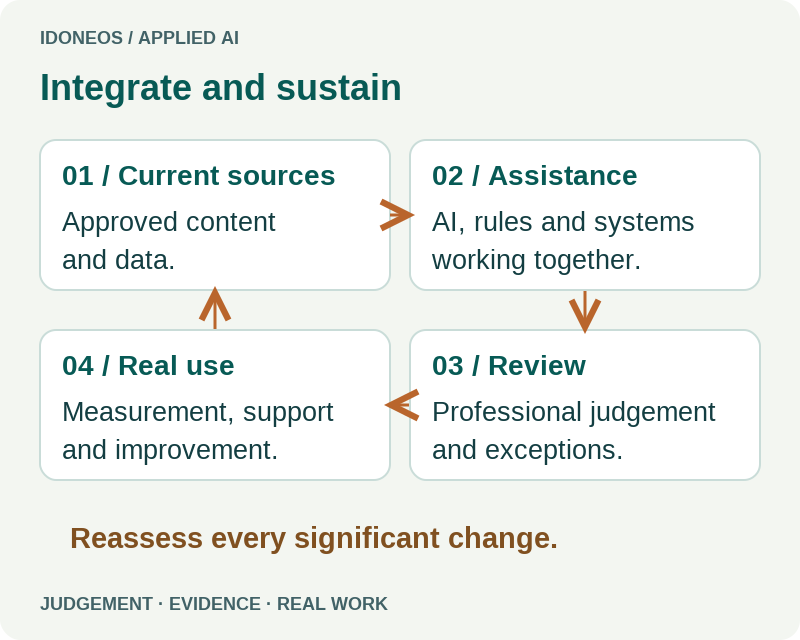
The diagram represents a process that requires approval before acting. Follow-up revisits its resources and decisions to study the changes needed.
Preparation, approval and action retain their meaning. Observing use lets us review the conditions that support the result. View larger diagram.
## Learn with the people who will use the solution
Training should allow people to practise recognisable tasks, including exceptions and how to continue when AI assistance is insufficient or unavailable.
To review a result, a person needs to understand what to check and have the means to do so. The responsibility assigned must match their judgement, information and time.
Use also reveals design difficulties. If people avoid a function, it helps to examine the effort it demands, the uncertainty it introduces or the part of the work it still leaves unresolved. That observation allows us to improve the solution and its integration.
## Sustain the conditions that produce the result
Data sources need people responsible for keeping them current. The process needs someone who can decide on scope changes. Technical operation needs attention when interruptions or modifications occur.
In a small team, one person may fulfil several roles. What matters is recognising who can intervene in each problem and with what authority.
We also need to retain a way to evaluate changes. A new data source, a modified instruction or a different component can alter the results. Accumulated evaluation cases let us check whether the solution maintains the quality that justified its use.
## Check that the value becomes a reality
Once the solution is integrated, we return to the initial purpose that gave rise to it. Has the result improved? Has total effort decreased? Which errors occur? Does the released time allow the intended work to be done?
People's use of the tool indicates whether it plays a part in the activity. To judge its contribution, we need to relate results and costs, including review, maintenance and dealing with problems.
That follow-up lets us decide what to retain, what to correct and where expanding the scope makes sense.
The process also leaves an organisational capability: understanding the work better, making criteria explicit, maintaining sources and evaluating interventions. Those resources can support further improvements. Each project can then begin with a stronger foundation of knowledge than the one before.
Next step
Recognise an opportunity in your business
The process starts by understanding what you want to achieve and which work deserves an improvement. You can return to the first guide with that question.