Articles · Applied AI
Which recorder to choose for expert interviews
An expert’s explanation may depend on a single word, a condition or the interviewer’s question. In How to capture expert knowledge with audio and AI, we worked through the process of interviewing, transcribing and validating that knowledge. To work with the explanation afterwards, we need to preserve it clearly and be able to retrieve the audio.

The recorder choice we also had to make
To bring this method into our own work, we faced a concrete decision: which device should we use to record the interviews, and how would we then bring its files into our analysis environment? That need led us to compare the following options.
We wanted to hear the questions and replies clearly, retain the original and choose our own transcription, analysis and storage services. If a transcript confuses a part name or loses a negation, we need to listen again to what was said. Keeping the audio allows us to review the interpretation. That makes ease of file retrieval part of choosing a recorder.
We can begin that check with a phone, before buying anything. A brief trial lets us examine whether the application keeps recording with the screen locked, whether we can prevent interruptions and how we export the file. Working through those steps helps us understand what a dedicated recorder would need to make easier to be worth adding.
The first condition is acoustic: bring the microphone closer to the voices and reduce noise and reverberation. That placement determines the signal we will have to listen to and process later. Device functions can help within the conditions in which sound is captured. Shure’s guide to microphone techniques develops these principles.
Sony ICD-UX570: voice recording and direct file access
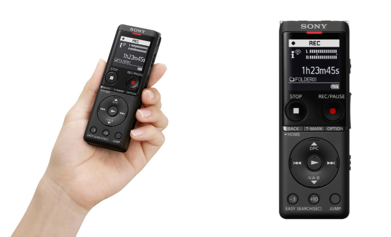
The Sony ICD-UX570 allows us to copy files to a computer over USB. That direct access fits our purpose: once we have retrieved the audio, we can choose which tools to use for transcribing, analysing and retaining it. The choice of those services remains separate from the recorder.
The device has a built-in rechargeable lithium-ion battery, LPCM recording at 44.1 kHz and 16 bits or MP3, a microphone input and a headphone output. Its official specifications let us check those features and prepare what the interview requires.
The Focused and Wide modes let us adapt capture to the arrangement of the voices. What we want to preserve matters again here: if an answer depends on the question preceding it, both need to be audible. The placement and recording-mode trial should include the expert and the interviewer.
Sony ICD-PX470: an alternative with replaceable batteries
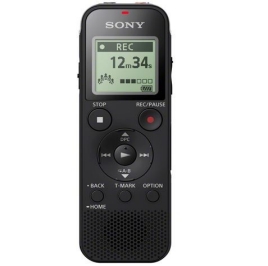
The Sony ICD-PX470 supports the same workflow: record locally and copy the files to a computer through its built-in USB connector. It also records LPCM at 44.1 kHz and 16 bits or MP3, and provides stereo microphones, an external microphone input and a headphone output.
Once file access is resolved, another practical difference appears: the PX470 uses two replaceable AAA batteries and does not recharge them over USB; the UX570 has a built-in rechargeable battery. If we need to renew the power supply during a working day, we can carry spare batteries for the PX470. If we prefer recharging the device itself, the UX570 fits that arrangement. The PX470 specifications and Sony’s power-supply information let us check the distinction.
In our selection, the PX470’s easier availability in Argentina was another reason to include it. It broadens the options for organising this work while retaining the ability to choose transcription and analysis services separately.
Zoom H1essential: room to adjust levels
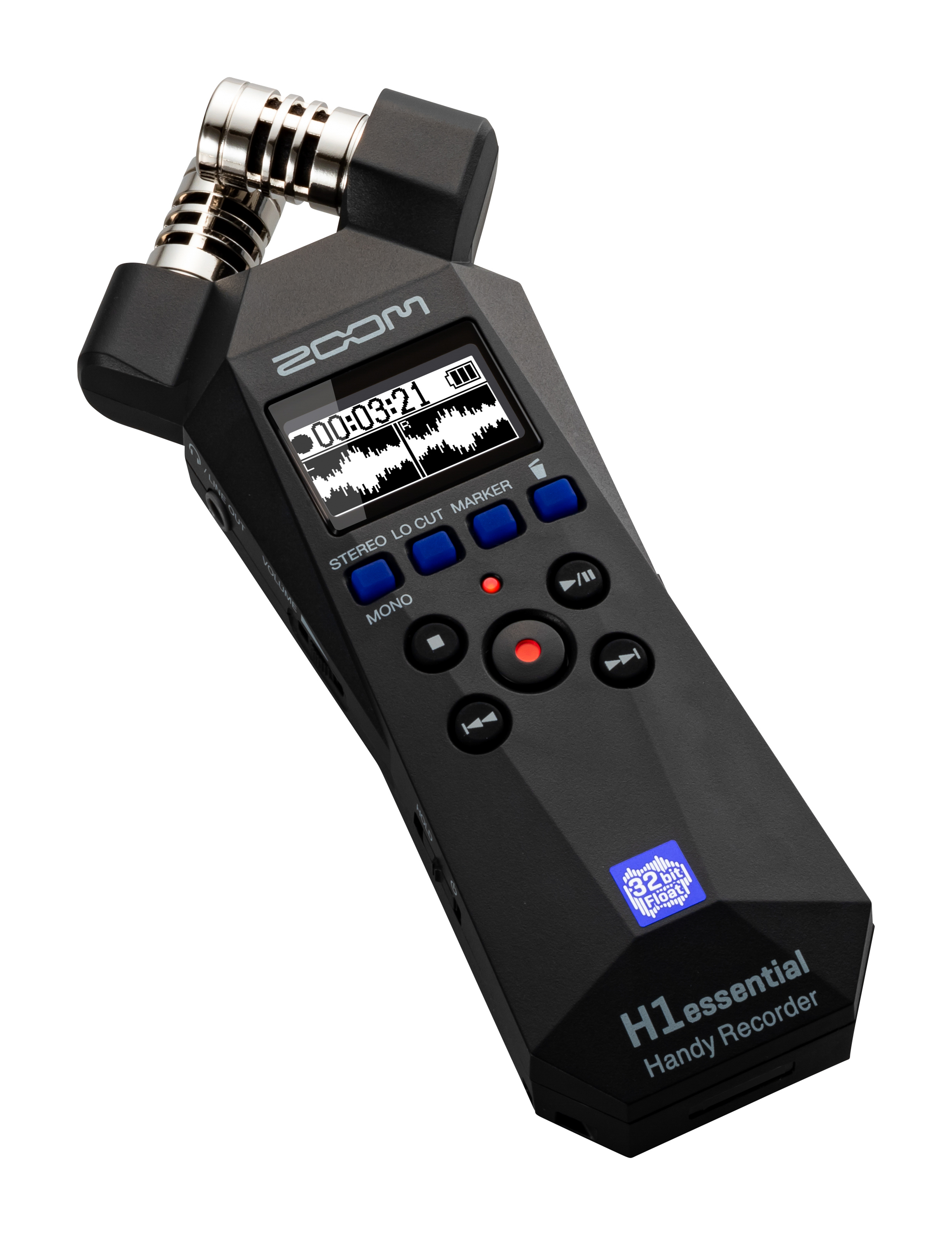
If voices vary greatly in volume during an interview, more room to adjust their levels afterwards may interest us. The Zoom H1essential records 32-bit float WAV and provides X/Y microphones, a 3.5 mm external input and USB-C transfer. Its manual also explains how to export to 16 or 24 bits when an application requires it.
It helps to be precise about what that format contributes. It leaves broad room to adjust the recorded audio level, within what the microphone and electronics were able to capture. A distant voice mixed with noise will still need better microphone placement or configuration. Sound Devices’ technical explanation helps distinguish capturing the signal from representing it in a file.
That flexibility may justify the device’s additional preparation for voices with variable volume or broader audio uses. The H1essential needs a memory card and uses two AAA batteries or USB power. We also need to consider how we will connect an external microphone: its input replaces the built-in microphones, so we cannot record all of them as independent tracks.
Plaud Note Pro: an integrated workflow with its service
With Plaud Note Pro, the organisation of the work changes: recording is integrated with a transcription and analysis application. We may prefer that workflow if we want to handle those operations within one service. To understand what it involves, it helps to follow the file from recording to the point where we can use it.
According to its transfer documentation, Note Pro does not provide USB access to recordings. They first transfer to the application over Bluetooth or Wi-Fi; from there, we can export the audio. To work with our own tools, we need to go through that application as an intermediary.
This explains why it would not be our first choice for the workflow we are preparing, although it may suit someone who prefers the integrated service. Recording, exporting audio and using transcription are distinct operations. Transcription plans and quotas apply to processing: when choosing, we need to relate the file’s path to the use we expect to make of that service.
Which criteria guide our choice
We can now return to the initial question with a more precise criterion. If we want to record interviews and process the files with our own tools, both Sony models offer a direct workflow. Local availability and how we organise the power supply help us choose between them. The Zoom deserves consideration when we will use its room for adjusting levels or its additional audio capabilities. Plaud suits a preference for an integrated service, with the application as part of the workflow.
This selection draws on manufacturer documentation consulted on 2 November 2026. We have not conducted our own acoustic comparison of the four devices. To move forward, we need a representative sample: questions, softly spoken answers, technical terms and the usual background noise, processed with the same service and settings. We want to check errors in names and negations, correction time and ease of file retrieval. If something fails, we can return to the audio, distinguish whether capture, transcription or our interpretation needs improving, and repeat the trial.
The trial will be sufficient for a decision when we can preserve and interpret that conversation with the quality and review effort our work requires. The original audio will remain available for returning to the expert, correcting an interpretation or trying another tool. That is the purpose guiding the following comparison.
| Option | When to consider it | How we retrieve the audio | What we need to check |
|---|---|---|---|
| Available phone | First interview and trial of the method | Export depends on the application | Clarity of both voices and uninterrupted recording |
| Sony ICD-UX570 | Interviews and a preference for a built-in rechargeable battery | Direct USB copy | Device charging and capture of both voices |
| Sony ICD-PX470 | Interviews and a preference for replaceable batteries | Direct copy through built-in USB | Two AAA batteries; no USB recharging; capture of both voices |
| Zoom H1essential | Variable levels and additional audio uses | Files over USB-C or memory card | Card, power supply and possible format export |
| Plaud Note Pro | Preference for integrated transcription and analysis | Transfer to its application and subsequent export | Application dependency and the chosen plan’s quotas |
Purchase links
| Device | Mercado Libre | Amazon US | Amazon ES |
|---|---|---|---|
| Sony ICD-UX570 | Mercado Libre | Amazon US | — |
| Sony ICD-PX470 | Mercado Libre Argentina | — | — |
| Zoom H1essential | Mercado Libre | Amazon US | Amazon ES |
| Plaud Note Pro | Mercado Libre | Amazon US | Amazon ES |
Affiliate links. If a purchase is made through these links, Idoneos may receive a commission.
As an Amazon Associate I earn from qualifying purchases.